

Inaugural Hall of Fame Class: Noting the Best
9/29/2009 12:00:00 AM
Celebrating Pioneers in Liberty Athletics History
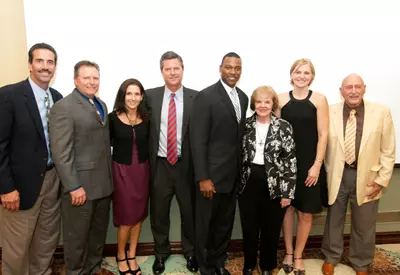
2009 Hall of Fame banquet photo gallery
In 1971, Dr. Jerry Falwell saw something begin to come to fruition, something that had previously been just a dream. One of the world's leading Evangelical preachers of his time, Falwell longed to properly educate the youth of America.
Falwell dreamed of an educational system where a child could enter at a kindergarten age and remain under the same umbrella until the Ph.D. level. He wanted a place where that student could sit all the while under the instruction of born-again teachers and professors, ones who clung to the same beliefs Falwell had been preaching from his pulpit at Thomas Road Baptist Church since 1956.
In the fall of 1971, 143 students entered through the doors of then Lynchburg Baptist College, beginning the final educational level of Falwell's dream. Now, some 39 years later, Liberty University stands as the leading Evangelical university in the world, housing over 11,000 residential students and roughly 38,000 students in Liberty's distance learning program.
Falwell, who had a special place in his heart for young people throughout his six decades of ministry, knew the best way to reach the younger culture was via two avenues which spoke to their immediate level of interest – music and sports.
From the onset, Falwell made these two aspects of the school beacons, quickly spreading the name "Liberty" throughout the country and around the globe to continue his ultimate dream of having 25,000 residential students on Liberty Mountain.
During the first year it opened its doors, Liberty fielded its first athletics program, as the men's basketball team took to the hardwood. Liberty defeated Southland College, 88-45, in its' first-ever athletics contest, jump starting a 7-1 opening season.
The following fall, Liberty sent its best student-athletes out onto the gridiron, when the Flames fielded their first football team in 1973. Under Lee "Rock" Royer, Liberty prepared for battle on the practice fields at Treasure Island and played their home events at Brookville High School and Lynchburg's City Stadium.
Following three setbacks to open the year, the Flames closed out the season strong with a trio of victories to complete their first year with an even 3-3 mark.
Over the next four decades, a once small and, at times, fledging athletics department quickly moved up the ranks, starting out at the National Christian Collegiate Athletic Association level. On Sept. 1, 1988, Liberty joined the nation's elite collegiate programs when the athletics department gained full-time NCAA Division I status.
Four years later, Liberty Athletics gained conference affiliation with the Big South Conference and has since dominated the league. During the past 18 years in the conference, Liberty has become the league's elite program, earning 88 conference titles and capturing seven Big South Sasser Cup titles, an honor given to the league's best overall athletics program each academic year.
Now in the midst of its fourth decade of existence, Liberty Athletics decided last April to begin to honor some of those who have paved the way for Liberty's current student-athletes. Under the direction of Athletic Director Jeff Barber, a committee was formed to select Liberty's inaugural Hall of Fame class.
From a pool of more than 100 former student-athletes, coaches, administrators and key supporters, the committee continued to toil over the list, successfully narrowing the pool down to an elite group of seven impact individuals.
Liberty's "magnificent seven" each proved to be pioneers in their sport or field, laying a foundation which Liberty's coaches and current student-athletes now use to compete at the highest level of intercollegiate athletics.
On Sept. 25, before a crowd of more than 100 individuals, the accolades and accomplishments of these seven were heralded from inside the main ball room of Lynchburg's Holiday Inn Select at Liberty's inaugural Hall of Fame Banquet.
As the third-largest crowd in Williams Stadium history braved steady downpours throughout the evening of Sept. 26, which left more than an inch of rain, Liberty's "magnificent seven" were once again honored before the crown of 15,532, who were there to watch No. 24 Liberty battle No. 24 James Madison.
Below is a brief glimpse into the heralded seven-member class, and how they helped make Liberty Athletics what it is today.
Dr. Jerry Falwell (Founder)
Presented at the Hall of Fame Banquet by: Jeff Barber (Liberty's Director of Athletics)
Dr. Jerry Falwell will long be remembered as Liberty's No. 1 fan, as the sports fanatic had a vision of Liberty Athletics competing alongside the nation's best from the day he opened the doors at then-Lynchburg Baptist College.
Falwell's presence at athletics events often spurred Liberty student-athletes to victory over the years. The founder rarely ever missed a home event, while he traveled the country cheering Liberty's best until he passed away. At his home-going celebration, 10 Liberty student-athletes served as honorary pallbearers, exhibiting Falwell's passion for athletics.
Arthur L. Williams (Athletics Financial Supporter)
Presented at the Hall of Fame Banquet by: Neal Askew (Business Partner)
Arthur L. Williams, the founder of Primerica Financial Services, has long been one of Liberty Athletics strongest supporters since he was first introduced to the program by Dr. Jerry Falwell during the mid-1970s.
Williams' financial generosity over the years helped a small NCCAA program quickly transition to the NCAA Division I level. Several athletics facilities around the campus still bear his name, including Williams Stadium and the Williams Football Operations Center, home to Liberty's two-time defending Big South championship football program.
Sid Bream (Baseball)
Presented at the Hall of Fame Banquet by: Al Worthington (former Liberty baseball coach)
Sid Bream was one of Liberty's first true athletic stars, earning NAIA and NABC All-America honors during his time at first base for the baseball program. He still holds seven different baseball program records, including the career mark for batting average (.435) and slugging percentage (.830).
Bream was drafted by the Los Angeles Dodgers in the second round of the 1981 MLB Draft. The 12-year major leaguer and the 1990 Hutch Award winner, Bream helped the Pittsburgh Pirates to the National League Championship Series in 1990 and the Atlanta Braves to back-to-back World Series appearances in 1991 and 1992.
Kelvin Edwards (Football)
Presented at the Hall of Fame Banquet by: Theo Caldwell (former Liberty assistant football coach)
Kelvin Edwards helped the athletics department's flagship program make the move to the NCAA ranks, as the wide receiver shined for the football program during a star-studded four-year career. A 1985 Associated Press Little All-America first-team honoree and Blue-Gray Football Game participant, Edwards still holds the program records for career receiving yards (2,546) and career receiving touchdowns (24).
Upon graduating from Liberty, Edwards became Liberty's second-highest NFL draft pick, when he was selected in the fourth round of the 1984 draft by the New Orleans Saints. His three-year professional football career was spotlighted when he was a starting wide-out for the Dallas Cowboys.
Karl Hess (Men's Basketball)
Presented at the Hall of Fame Banquet by: Kevin Keys (Liberty's Associate Athletics Director)
Karl Hess helped put Liberty Basketball on the national scene. He became the men's basketball program's all-time leading scorer with 2,373 points and dazzled fans on the hardwood. Hess capped off his four-year career at Liberty by leading the Flames to a 28-11 and an NCCAA national championship in 1980, earning tournament MVP honors during the event.
The CoSIDA Academic All-America first-team honoree still holds 12 program records, including six career standards. Still active in the game, Hess is now considered to be one of the nation's top referee's, primarily officiating ACC, BIG EAST and SEC men's basketball games. In 2007, he served as the crew chief for the national championship game between Florida and Ohio State.
Elena (Kisseleva) Bengds (Women's Basketball)
Presented at the Hall of Fame Banquet by: Rick Reeves (former Liberty women's basketball coach)
Elena (Kisseleva) Bengds helped turn a fledgling women's basketball program into one of the Big South Conference's longest-running dynasties. During her magnificent four-year career, the Moscow, Russia, native led the Lady Flames to four-straight league titles and the first four of 10-straight NCAA Tournament berths.
The two-time Big South Player of the Year still lays claim to 12 program records, including the career mark for points scored (2,154) and minutes played (3,860). During the 1997-98 season, Bengds helped the Lady Flames enter the 1998 NCAA Tournament with an unblemished 28-0 record, where they faced eventual national champion Tennessee in the only NCAA Tournament matchup of two unbeaten programs in women's basketball history.
Bob Bonheim (Wrestling/Football Coach)
Presented at the Hall of Fame Banquet by: Jesse Castro (Liberty's head wrestling coach)
Bob Bonheim orchestrated the first true national powerhouse at Liberty, guiding the Flames wrestling program to five-straight NCCAA national championships (1977-1981). The two-time NCCAA National Coach of the Year (1976 and 1981) finished his days roaming the mats with a 118-31 dual meet record, winning at an impressive 79.2 percent clip.
A 2003 inductee into the Central Virginia Sports Hall of Fame, Bonheim coached 35 All-Americans, including eight at the NCAA level. Twenty-one of his grapplers went on to win NCCAA national titles. Bonheim, who also served four years as a defensive line coach for the football program, helped wrestling move from NCCAA to NCAA Division II, finishing fifth nationally during his final season as head coach in the Flames third year at the new level.
Todd Wetmore
Liberty University Assistant AD for Communications